Because some foreign tourists and foreigners who stay in Bali have started making troubles like refusing to show respect to local traditions, breaking traffic laws, picking fight with locals for unknown reasons, harassing local women, dealing drugs, refusing to go back home to their country despite their visit visas have expired and other things that cause disorder in Bali.
Is it too much asking for these two tourists to put on helmets like other drivers ? Its all about safety driving, which part of it they can’t understand ?
Look at these tourists bellow ? what did they do ? You put yourself in danger and you also put others in danger thanks to your action.
These tourists only wear bikini when driving scooters. Can’t they put some descent clothes and respect local norms ? Driving naked is not a culture in Indonesia.
Italian mafia boss, Antonio Strangio arrested in Bali
Indonesians are kind people who welcome foreigners coming to Indonesia but with smiles on their faces but Indonesians are no pushover, especially when their values, ways of life, beliefs and social environment are being disrespected by foreigners.
Are you searching for the right editor for your writing? (Photo by saeed mhmdi on Unsplash)
You’ve just found a great idea for a magazine or blog!
Now, how do you pitch this idea?
“That’s easy,” you might be thinking. “Just send your pitch to the editor.”
But finding an editor’s email address sometimes isn’t as easy as it sounds.
You will probably need to give your research skills a practice run by going on a search for an editor’s contact information.
Here are 7 tips on how to find editors’ email addresses.
1. Know Your (Editor’s) Role.
That is, try to find out exactly which editor is actually in charge of reading freelance pitches and submissions.
Large Magazines
For example, the editor-in-chief or executive editor of a national magazine usually doesn’t review freelance pitches. If you’re pitching a larger publication, try looking for the managing editor or the articles editor.
Blogs
Blogs usually have a smaller staff, compared to national magazines. Therefore, you’re more likely to find a blog editor’s email address on the website. Look for the blog’s “About Us” or “Contact” section or page to find an email address.
2. “Can’t I just shoot an email to the publication’s listed generic email address?”
Sure, you could.
If you do this for a blog, your email is more likely to be seen by a blog editor since they have a smaller staff.
But using a larger publication’s generic email address is like sending your pitch into a black hole.
Some writers and editors refer to these generic email addresses as “slush piles.” There’s only a small chance that anyone at the publication, further less an editor who can approve freelance pitches, will see your submission that you spent so much time creating for that specific publication.
3. Ask other writers.
Did you just read a great story in a magazine or blog? Notice the name of who wrote that story.
Then, do an internet search for more information about the writer.
If the writer’s email address isn’t listed below the story you read, you will probably find his/her email address on their own website/blog. Reach out to the writer and ask who to contact (and the contact editor’s email address) to pitch a story to that publication.
Also, if you’re pitching a local publication, ask local writers you know about who to contact.
You can also ask writers in any online writers’ groups that you belong to about contacting editors and publications. This is another reason why it’s important to join local and online writers’ groups, as I’ve mentioned in previous blog posts.
If you have some money to spare, you could also join a professional network of bloggers and/or writers that list editors’ information. One of the best networks is the Writer’s Market Online Directory.
4. Get Social.
Writers often ask, “What’s the point of social media? Can it really help me as a writer?” Yes, especially when it comes to trying to find the right editor to pitch your story or article.
Twitter
Of the “Big 3” social media sites (Facebook, Twitter and LinkedIn), Twitter gets the most skepticism about whether it can help writers.
But writers can use Twitter to get noticed by editors.
How?
Follow editors on Twitter.
Begin liking, commenting and retweeting their tweets. Tweet about articles and blog posts from their publications and tag the editor, especially if that editor wrote the article/blog post.
If the editor follows you back, send them a direct message on Twitter and ask for their email address to pitch them. Mention that you searched online but couldn’t find an email address and that you want to make a personal impression.
Facebook
Does the editor have a professional Facebook page (instead of just a personal page)? If so, reach out to the them, using some of the same steps for connecting via Twitter (i.e.: like their Facebook posts, leave comments, etc.).
Also, the publication’s Facebook page information might list the editor’s email address.
LinkedIn
LinkedIn lends itself to a different approach compared to Facebook and Twitter. LinkedIn can be another way to find an editor’s email address.
But don’t try to connect to an editor on LinkedIn with a connection request or a LinkedIn direct message, since you don’t personally know the editor.
Now, if you and the editor have a mutual contact on LinkedIn, then reach out to that contact directly. Tell the contact that you want to pitch a story to the editor. Ask the contact if they know the editor and would they introduce you, or do they have the editor’s work email address.
5. Use advanced searches for email addresses.
Still having trouble finding an editor’s email address?
You could make educated guesses about the editor’s email address. For example, if you know that Mary Smith is a magazine editor, then there’s a chance that Mary’s email address could be something like msmith@magazine.com, or marysmith@magazine.com, or marys@magazine.com.
You can then use email address finder websites like Verify-Email.org, to check these email addresses.
6. Try the media press kit.
Look for the media section (or a similar section) on the magazine’s website. If the magazine has a media press kit on their website, that kit usually includes the magazine’s public relations department’s contact information. This information could also lead you to an editor’s email address.
7. Get on the phone.
Call the magazine and when someone answers, you can say, “Hi, I have a great idea for your ‘Parenting Tips’ section, and I have the assigning editor’s email address as MarySmith@magazine.com. Can you confirm?”
Most of the time, the person will either confirm that email address or give you the correct email address. Or, if that’s the wrong editor to pitch a story to, the person might even tell you who to pitch instead.
Final Thoughts
Whew! This might seem like a lot of work for a simple email address. Just remember that editors are busy, but they still need a steady flow of great stories and articles for their publications.
Doing your homework and getting an editor’s email address can pay off, literally, if your article is accepted and published.
Written by Maya Spikes
I help writers create blog posts & reach more readers. Visit: mayaspikes.com/ideas
Learn how to write and send effective print and e-mailed letters to editors of various media types, together with examples, that will gain both editorial and reader support.
WHAT IS A LETTER TO THE EDITOR?
WHY SHOULD YOU WRITE A LETTER TO THE EDITOR?
WHEN SHOULD YOU WRITE A LETTER TO THE EDITOR?
SHOULD YOU USE E-MAIL TO SEND YOUR LETTER?
HOW DO YOU WRITE A LETTER TO THE EDITOR?
HOW DO YOU GET YOUR LETTER ACCEPTED?
WHAT IS A LETTER TO THE EDITOR?
You feel strongly about an issue, and you want to let people know what you think. You believe you can even influence people to take some action if you speak your mind. But, you want to reach an audience larger than just your friends or your group membership. Letters to the editor can be an effective way to get the word out.
A letter to the editor is a written way of talking to a newspaper, magazine, or other regularly printed publication. Letters to the editor are generally found in the first section of the newspaper, or towards the beginning of a magazine, or in the editorial page. They can take a position for or against an issue, or simply inform, or both. They can convince readers by using emotions, or facts, or emotions and facts combined. Letters to the editor are usually short and tight, rarely longer than 300 words.
Using a few carefully placed letters, you can generate plenty of community discussion. You can also keep an issue going by preventing it from disappearing from the public eye. You can stimulate the interest of the news media and create more coverage for the matters you’re working on. You can also send a “good news” letter to bring recognition to people who deserve it or acknowledge the success of an effort.
WHY SHOULD YOU WRITE A LETTER TO THE EDITOR?
Letters to the editor are among the most widely read features in any newspaper or magazine. They allow you to reach a large audience. You can probably think of many more specific reasons why you might want to write to the editor, but here are a few general ones:
You are angry about something, and want others to know it
You think that an issue is so important that you have to speak out
Part of your group’s strategy is to persuade others to take a specific action
Or you want to:
Suggest an idea to others
Influence public opinion
Educate the general public on a specific matter
Influence policy-makers or elected officials directly or indirectly
Publicize the work of your group and attract volunteers or program participants
WHEN SHOULD YOU WRITE A LETTER TO THE EDITOR?
Letters to the editor can be written any time you want to shape public opinion, tell others how you feel about people, programs, or ideas, or just inform the public on a certain issue. They are a great way to increase awareness of the issues that you or your organization are working for, as well as to advocate for your cause.
Letters to the editor can also be used to start a community conversation about an issue important to you. A planned series of letters to the editor can stimulate public interest and media coverage. It’s up to you to determine when is the best time to start writing the letters, allowing time for them to be published.
The larger the newspaper or magazine, the more competition there is for letters-to-the-editor space. This means your letter will need to stand out in order to get printed. The tips in this section will help you write a letter that will be effective and stand out on the editor’s desk.
Keep in mind that if you want to inform the public of a certain action your organization is about to take, you may want to think of issuing a press release instead. If newspapers consistently ignore your news releases, your best choice may be a letter to the editor.
HOW SHOULD YOU SEND YOUR LETTER?
The reality for virtually every print publication is that they’d prefer to get letters and other material by e-mail, since everything they publish is set up on a computer and printed straight from software. If you send your letter electronically, all they have to do is transfer it directly to the “letters” page in the software in order to print it.
You can still send a postal letter, of course, but someone has to type it into the computer before it can be printed, and so it may not only arrive later than an e-mail, but may wait longer after it’s received to be printed.
HOW DO YOU WRITE A LETTER TO THE EDITOR?
OPEN THE LETTER WITH A SIMPLE SALUTATION.
Don’t worry if you don’t know the editor’s name. A simple “To the Editor of the Daily Sun,” or just “To the Editor:” is sufficient. If you have the editor’s name, however, you should use it to increase the possibilities of your letter being read.
GRAB THE READER’S ATTENTION.
Your opening sentence is very important. It should tell readers what you’re writing about, and make them want to read more.
EXPLAIN WHAT THE LETTER IS ABOUT AT THE START.
Throughout your letter, remember the rule:
Be quick,
Be concise, and then
Be quiet.
Don’t make the editor or the general public wait to find out what you want to say. Tell them your key point at the beginning.
EXPLAIN WHY THE ISSUE IS IMPORTANT.
If you are motivated enough to write a letter to a newspaper or magazine, the importance of your topic may seem clear to you. Remember, though, that the general public probably doesn’t share your background or the interest. Explain the issue and its importance simply. Use plain language that most people will understand
GIVE EVIDENCE FOR ANY PRAISE OR CRITICISM.
If you are writing a letter discussing a past or pending action, be clear in showing why this will have good or bad results.
STATE YOUR OPINION ABOUT WHAT SHOULD BE DONE.
You can write a letter just to ”vent,” or to support or criticize a certain action or policy, but you may also have suggestions about what could be done to improve the situation. If so, be sure to add these as well. Be specific. And the more good reasons you can give to back up your suggestions, the better.
KEEP IT BRIEF.
Generally, shorter letters have a better chance of being published. So go back over your letter and see if anything can be cut or condensed. If you have a lot to say and it can’t be easily made short, you may want to check with the editor to see if you could write a longer opinion feature or guest column.
SIGN THE LETTER.
Be sure to write your full name (and title, if relevant) and to include your address, phone number, and e-mail address. Newspapers won’t print anonymous letters, though in some cases they may withhold your name on request. They may also call you to confirm that you wrote the letter before they publish it.
CHECK YOUR LETTER TO MAKE SURE IT’S CLEAR AND TO THE POINT.
A newspaper may not print every letter it receives, but clear, well-written letters are likely to be given more serious consideration.
HOW DO YOU GET YOUR LETTERS ACCEPTED?
How likely your letter is to be published depends to a certain extent on the publication you’re sending it to. The New York Times probably receives hundreds, if not thousands of letters a day, only ten or so of which make it into print. A small-town newspaper, on the other hand, may print every letter it gets, since it may get only two or three a day.
In general, newspapers and magazines will publish letters that are well-written and articulate, and that either represent specific points of view on an issue, or that thoughtfully analyze complex issues and events. Most publications stay away from publishing rants, although they may publish short-and-to-the-point letters that make the same points as a rant might, but in a much calmer and more rational way. Publications also tend to stay away from attacks on particular people (although not from criticism of the actions of politicians and other public figures), and anything that might possibly be seen as libel.
Legally, libel is the publication of a false statement about someone that damages that person’s reputation. Thus to falsely accuse someone of a crime would be libel; to inaccurately print that someone had won an award for citizenship would not be.
Here are a few helpful tips for getting your letters accepted by the editor:
Keep your letter under 300 words. Editors have limited space for printing letters, and some papers have stated policies regarding length (check the editorial page for this).
Make sure your most important points are stated in the first paragraph. Editors may need to cut parts of your letter and they usually do so from the bottom up.
Refer to a recent event in your community or to a recent article – make a connection and make it relevant.
Use local statistics and personal stories to better illustrate your point.
Make sure you include your title as well as your name – it adds credibility, especially if it’s relevant to the topic being discussed. If you are a program director, your title may lend credibility to the letter.
Including your title is also important to showing that you’re not trying to hide your interest in the topic. If you’re a program director and you don’t mention that in your letter, there may be a letter the next day accusing you of dishonesty for not revealing it.
Editors may want to contact you, so include your phone number and e-mail address.
If your letter is not accepted the first time around, try again. You might submit a revised version with a different angle on the issue at a later date.
You do not have to be the only one to write the letter: letters are often published with multiple signers. You also don’t have to be the only one to write a letter. Several people may write letters on the same topic with the same or slightly different points, and submit them a few days apart, so that the issue stays on the Letters page for a period of time. If you have talented writers in your group, you might encourage one of them to write an editorial article or an “Op-Ed” – that is, an opinion editorial that is usually printed on the citizen opinion page. Most of all, don’t limit your communications. Brainstorm for ideas in your group – how can you further your goals by speaking to the readers of your community paper?
Contributor
Jenette Nagy
Online Resources
Advocating for Change is an online PDF provided by the Treatment Advocacy Center with tips to writing and submitting an effective letter.
Advocates for Youth provides this guide to writing a letter to the editor and gives ten tips and a sample letter.
Effective E-mail Communication from the University of North Carolina provides tips on professional e-mail writing and communicating via e-mail.
Media Communication Tip Sheet provides tips on contributing to the local news, tailoring language and style for the media, developing messages to reach the public, and evaluating media coverage.
Using Effective Communications from UNISON is a guide to communicating effectively in both formal and informal settings.
Using Print Media as Advocacy is an article titled, “How to Write a Letter to the Editor,” with tips on effective communication with the media.
Print Resources
Bates, J. (1985). Writing with precision. Washington: Acropolis.
Homan, M. (1994). Promoting community change. Making it happen in the real world. Pacific Grove, CA: Brooks
Martinez, B., & Weiner, R. (1979) Guide to public relations for nonprofit organizations and public agencies. The Grantmanship Center.
Roman, K., & Raphaelson, J. (1992) Writing that works. New York, NY: Harper-Collins, 1992.
Ryan, C. (1991). Prime Time Activism. South End Press.
Seekins, T., & Fawcett. S. (1984). A Guide to writing letters to the editor: Expressing your opinion to the public effectively. Lawrence, KS: Research and Training Center on Independent Living, University of Kansas.
Stonecipher, H. (1979). Editorial and persuasive writings: Opinion functions of the news media. New York, NY: Hastings House.
U.S. Government. Managing Correspondence – Plain letters, Washington, DC: Superintendent of Documents
Wallack, L., Dorfman, L., Jemigan, D., &Themba, M. (1993). Media advocacy and public health. Newbury Park. CA: Sage Publications.
The U.S. House of Representatives has recently proposed a law (H.R. no. 396) that will ban the sale of cigarettes from vending machines. This is a landmark piece of legislation that everyone in our community should support right now.
Many people don’t realize it, but vending machines are one of the main places that children are able to purchase cigarettes. In fact, it is estimated that 10% of all cigarettes purchased by minors take place at these machines. If this new legislation goes into effect, it will not only make it more difficult for youth to break the law by buying cigarettes, it will lower the chances of young people smoking in the first place
There are many reasons (besides the legal ones) why we should try to curb smoking by our children. 1) Research shows that most people who smoke started when they were underage. 2) Many people fear that smoking cigarettes serves as a “gateway” to harder drugs. 3) Smoking is a very expensive addiction (particularly for a teen who makes minimum wage) And, finally, 4) smoking can cause many life-shortening or fatal health problems (such as lung cancer and emphysema). Our young people would not smoke before they are really able to understand or accept the long-term consequences.
The vending-machine bill has been proposed, but now it needs to be passed. Your voice will count here. We encourage you to write or call the representative for your district (for those of us in District 8, that’s Congresswoman Fisher) and let her know that you support her as she tries to get this legislation passed. The more support she gets, the more likely it is that this bill will become law. Contact Tobacco Free Youth for further information about this important issue.
Sincerely,
Jonathan Friedman, Director Tobacco Free Youth 123 Forest Road
To the editor of the Lawrence Journal World:
Bulldozers began moving dirt last week at Lawrence High School and the Centennial Virtual School, but city commissioners and school district officials have been bulldozing this community for months with an athletic facilities expansion plan that is fiscally irresponsible, unnecessarily redundant and probably illegal. Our elected officials have misled the public, violated zoning codes and set taxpayers up for a $10.3 million loan that will take 10 years to pay off and cost taxpayers $2.25 million in interest.
Why was the public repeatedly told that this project could be built with leftover bond money when those funds don’t even represent a third of the proposed budget?
Why is it necessary to build two separate football stadiums at a cost of $4 million?
Why is it inconceivable to parents that both teams could play in a shared stadium at FSHS? The situation would be no different than it is in swimming, where both schools compete at the Indoor Aquatic Center.
Why are city commissioners allowing the school district to build a stadium for 4,000 spectators at LHS without also requiring the district to provide the 1,300 parking spaces required by city zoning ordinances?
Why did the school district repeatedly assert that the proposed facilities would only disrupt neighbors a few nights a year when it clearly intended to lease the fields for nightly city softball, baseball and soccer games?
We need new leaders with a clear vision, a commitment to fiscal responsibility, and the ability to balance community and educational needs.
Jerry Schultz, Bob Tryanski, Jeanne Klein and 10 other signers,
Lawrence
To the Editor of The Herald:
I am outraged by the County Commission’s recent decision to terminate the lease of the Head Start program at the County Court House. With this decision, a much-needed, already under-funded program may simply have no place to go!
Head Start is a fantastic program. It makes sure that poor and other at-risk pre-school children will have the nutritious food and special attention they just may not get elsewhere. It gives these children a true “head start” in a world where they may not get many other chances. And there is plenty of evidence to show that Head Start makes a big difference to kids later in life.
The Commission’s recent decision to oust the program to make more room for a ”state Gifts Shop” is ridiculous! If the leaders of our community would like to run a store to sell Kansas-made goods, I’m all for it. However, neither my Kansas pride nor my greed run so deep as to wish to take away the breakfast of 30 hungry three-year-olds. And I am deeply saddened to see that the County Commissioners value profits over people.
This decision is shameful to all who live in Dade County. The County Commissioners should reconsider the situation and revoke their decision immediately. I hope all readers will let the commissioners know how they feel about this terrible situation by calling them at 913-432-1200 or writing to them at the County Court House.
Sincerely,
Victoria Stein 3960 Mount Hope Drive 567-8095
TOOL #1: LETTER-WRITING PARTY
The responsibility of writing a letter to the editor can be shared. One way to do this is to hold a letter-writing party, at which you and your friends or colleagues write a planned series of letters that will be sent to the editor. At the party
Pick your topic.
Have each friend write a letter addressing the topic–these are Group #1 letters.
Have each friend write a draft letter in response to letters from Group #1–these are Group #2 letters. These will be left incomplete so that specific references to Group #1 letters can be filled in.
Make a few of your letters provocative so that others will respond.
Get permission from others to sign their names so that one person can handle the campaign.
Use different types of stationery.
Send copies to the “signer” as the paper may call him or her.
Let the “signer” know if the letter is published.
It may require only 5 or 6 people to develop a huge community response.
Mail Group #1 letters. Some may be published. Mail Group #2 letters, with specific information related to those published added, in response to them soon after the Group #1 letters are published. This exercise is great for group morale. It can be fun, too.
The Duchess of Sussex has criticised the “seemingly endless toxicity” of social media, revealing she was targeted with “bullying and abuse” while pregnant with Archie and Lilibet.
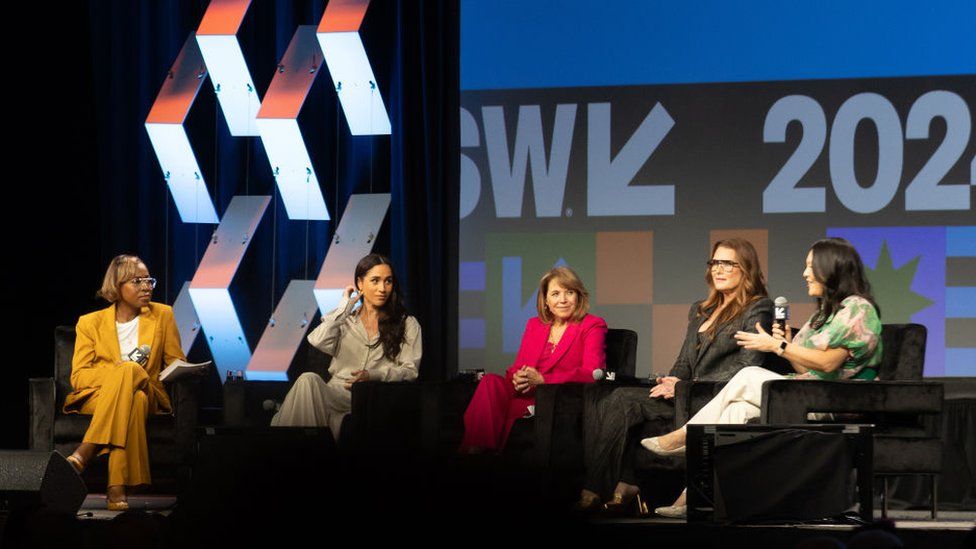
Meghan was the keynote speaker on a high-profile panel marking International Women’s Day at the annual SXSW festival in Austin, Texas.
She said she now keeps her distance from such comments for her wellbeing.
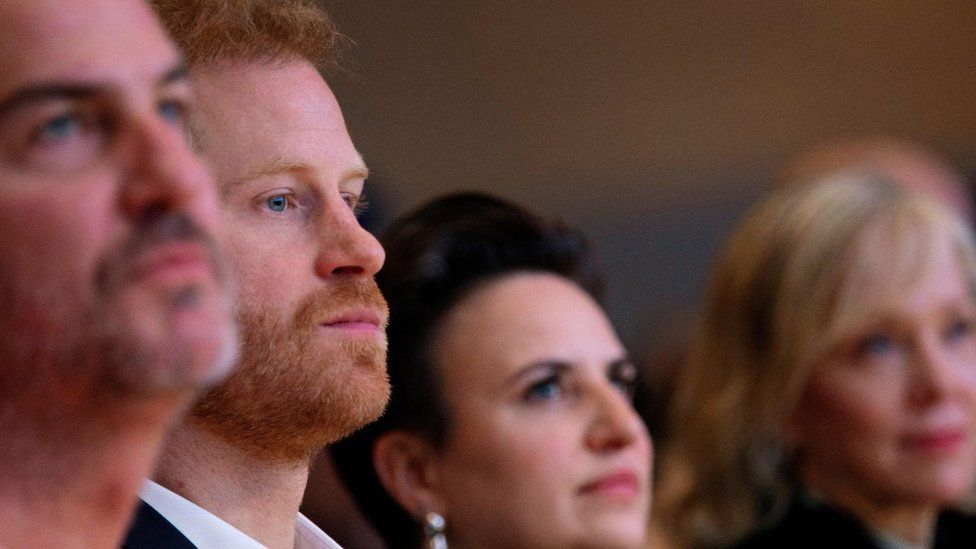
Prince Harry was in the front row of the audience watching the event.
Meghan said people have “forgotten our humanity” in certain parts of the media and digital sphere.
“The bulk of the bullying and abuse that I was experiencing on social media and online was when I was pregnant with Archie and with Lili”, she explained.
“You just think about that and really wrap your head around why people would be so hateful – it is not catty, it is cruel.”
The event was titled Breaking Barriers, Shaping Narratives: How Women Lead On And Off The Screen.
The 42-year-old former Suits actress also discussed issues ranging from the importance of diverse representation to portrayals of motherhood in film and entertainment.
Image caption,Panellists from left to right: Journalist Errin Haines, Meghan, former news anchor Katie Couric, actress Brooke Shields and sociologist Nancy Wang Yuen
Meghan said she found it “disturbing” that women were “spewing” hatred at each other online, adding: “I cannot make sense of that.”
“If you’re reading something terrible about a woman, why are you sharing it with your friends?” she asked.
“If it was your friend, or your mum or your daughter, you wouldn’t do it.
“I think that is the piece that is so lost right now (with) what is happening in the digital space and in certain sections of the media – we have forgotten about our humanity and that has got to change.”
At fellow panellist Katie Couric’s urging, Meghan also re-shared how a letter she sent aged 11 to consumer goods giant Procter & Gamble led to a sexist advert promoting dishwashing liquid being changed.
Meghan said that experience showed her the power of speaking up and advocacy. “Your voice is not small, it just needs to be heard,” she told a live audience.
Actress Brooke Shields, also on the panel. joked: “This is one of the ways we’re different, when I was 11 I was playing a prostitute,” referring to her background as a child actor and role in 1978 film Pretty Baby.
Rare appearances
The SXSW keynote panel event was also simultaneously streamed on YouTube, with most of the comments about Meghan being overwhelmingly positive.
The Duke of Sussex and Meghan have come under heavy criticism, particularly in the UK tabloid press, after they stepped back from the Royal Family.
Scrutiny of the couple intensified following a revealing interview on Oprah and a Netflix documentary.
The couple’s public appearances have been less frequent since they moved to California and set up the Archewell Foundation. Meghan was last in England in September 2022.
Image caption,Prince Harry in the audience at the event
There has been significant online speculation about a possible return to the UK to mark the 10-year anniversary of the Invictus Games – set up in 2014 by Prince Harry.
Meghan’s latest appearance comes during a difficult period for the Royal Family as the King undergoes cancer treatment and the Princess of Wales recovers from abdominal surgery in the UK.
They have been put further under the microscope by the appearance of Kate Middleton’s maternal uncle, Gary Goldsmith on Celebrity Big Brother.
On Friday evening, he became the first housemate evicted from Celebrity Big Brother on ITV.
Speaking after his eviction, Goldsmith backed the one-time Dragons’ Den contestant Levi Roots to win, adding that his niece would “100%” support his choice.
“[Roots] is somebody who puts other people first and that’s our Kate,” he said.